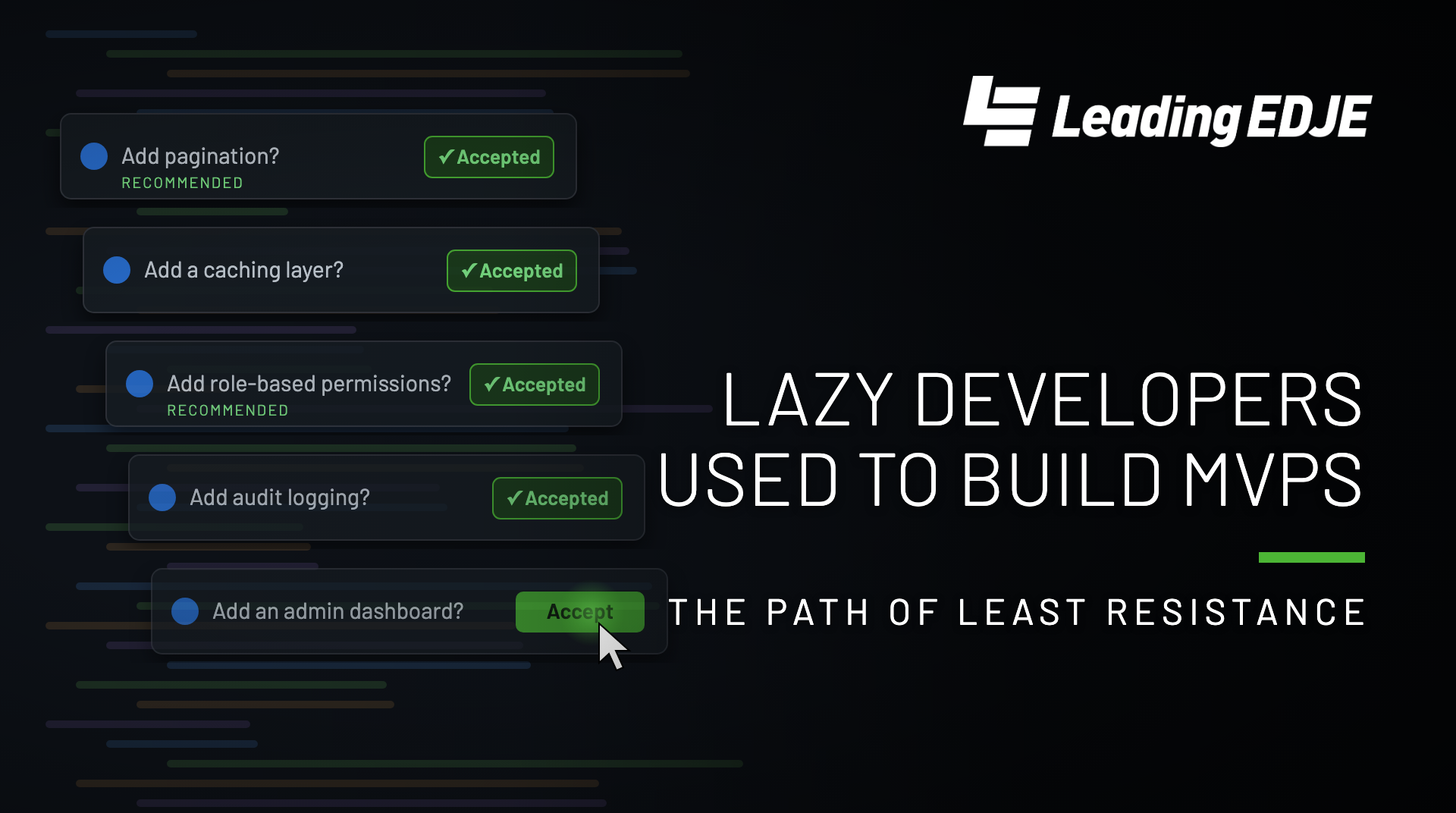
Lazy Developers Used to Build MVPs
How I let AI over-build a simple app, and what I'd do differently to keep it small.



Key Takeaways
- AI made code cheap to write but owning that code costs as much as it always has: it still has to be reviewed, debugged, secured and understood.
- When AI is missing context it fills the gaps with best practices written for scale, so a small app gets built like a company's.
- Automation bias makes accepting suggestions easier than questioning them, and future AI sessions treat the over-built code as the pattern to follow.
- Design the data, contracts and scope yourself before prompting, and tell the AI up front what you don't want it to build.
- Give standing instructions reasons, keep adding to them as you correct the AI, and ship the smallest thing that solves the problem.
I've always been a lazy developer, but with AI that habit helped me turn a simple family directory into an app I eventually scrapped. Here's how I let useful-sounding suggestions take over the project, and what I'd do differently to keep the next attempt small.
I mean lazy the way Larry Wall meant it when he called laziness the first great virtue of a programmer. I hate doing the same work twice, I automate anything I can, and I build the smallest thing that solves the problem because every extra feature is more work I'd rather not do.
For years that laziness kept my projects small. Building things took effort, so I only built what I needed. If a page was only ever going to have twenty items, I didn't bother adding pagination.
AI changed that. Saying yes to a suggestion now takes one keystroke, while saying no means stopping to think about whether I actually need it. I'm just as lazy as I was but now my laziness leads me to accept more instead of building less.
The path of least resistance used to lead to an MVP. Now it leads to gold plating.
Saying yes to everything
A while back I set out to build a family directory. The goal was simple: a place to look up relatives and see how they're related. I knew roughly what data I wanted, so I handed the AI some sample data, gave it a general idea of what I was after, and told it to go for it.
I never sat down and designed what the data should look like or defined the contracts between the pieces. I skipped the difficult part because the AI was right there and ready to do it for me.
So it made the decisions instead. It asked whether people should be able to edit their own information and that sounded nice, so I said yes. Then it suggested letting people update a deceased relative's record, or their children's, and I said yes to those too. Each idea seemed reasonable at the time and I barely thought about any of them.
Before long I had layers of authentication and user roles in an app that really needed two kinds of people: someone who could edit and everyone else. There was code in there I couldn't explain and rules I hadn't really chosen. The app looked nothing like what I'd pictured mostly because I'd never told the AI what I pictured.
I spent a long time going back and forth with it trying to get it back on track and eventually gave up and scrapped it.
What it actually cost
What I missed is that AI made code cheap to write but owning that code costs as much as it always has. Every line still has to be reviewed, debugged, secured and understood.
Reading has become the bottleneck. The AI produces more than I can comfortably take in, so I skim, and that's usually how gold plating gets in. I never decided to build a permissions system for a family directory. It slipped through while I was agreeing to things.
The bigger problem is what happens afterwards. These days the next reader of my code is usually another AI agent and agents treat existing code as the pattern to follow. When I accepted those roles and permissions, I was also teaching every future session that this is how the app works. Each new feature would have been built on top of that and made it a bit more tangled.
So the cost keeps growing over time. Every yes is a vote for how the next thousand lines get written.
Why it happened
It's tempting to blame the AI but it was doing what it's built to do. It was missing context, and when an AI is missing context it fills the gaps with best practices. Most best practices are written with scale in mind for problems much bigger than mine. The AI had no idea my directory would serve one family so it built it as if it were for a company.
I was the other half of the problem. When a tool gives you a confident recommendation, it's much easier to agree than to think it through. There's a name for this: automation bias, which is our tendency to trust what an automated system suggests. Being offered three options makes it worse. It feels like a real choice but there are rarely only three options, and picking the recommended one is usually the easiest thing to do.
Put together, those two things form a loop. The AI over-builds because it lacks context, I accept it because that's easy, and the next session reads the over-built code as context and builds on it. At no point does anyone ask whether any of it was needed.
How I'd build it now
I never went back to that directory but I've thought a lot about how I'd build it now. Most of the change happens before I open a terminal session or chat window.
First I'd design the data myself: who the people are, how they relate to each other, and what the app needs to store. That's the difficult part I skipped last time and I don't think it can be handed off. The AI will ask me about the big decisions but it makes a lot of small ones on its own based on best practices it doesn't always mention. If I haven't thought those through, they get decided for me.
Then I'd tell it up front what I want and what I don't. For this app that means only two roles: admins who can edit and users who can view. Nobody edits their own record to start with. The ideas that sank the first attempt, like letting people update a deceased relative's details or their children's can wait until someone actually asks for them.
I'd also ask for the simplest version that works and then ask what it left out. If something on that list matters, the AI can make the case for it and I can decide.
I'd still push back on suggestions as I go but I've learned that reacting to the AI isn't enough on its own. A lot of what it adds never comes up as a question, so if I wait to catch things I'll miss most of them.
Finally I'd ship something small: a way to look up family members and how they relate to their parents. That covers what we need today and anything else can come later if people want it.
Looking back, the effort I saved by skipping the planning didn't really go away. I spent it later going back and forth with the AI and ended up with nothing to show for it. Putting that effort in at the start would have got me the app I actually wanted.
A couple of fair objections
There are a couple of fair objections to all this.
The first is that AI-written code is disposable, so if something comes out over-built you can throw it away and generate a cleaner version. I did exactly that with the family directory, and for a proof of concept or a small personal project it's a reasonable option. In most real systems, though, it doesn't hold up. By the time you notice the problem, other code has followed the same pattern, your data is stored in that shape, and other systems depend on it. Users also expect the app to behave the same way it did yesterday. Regenerating code isn't deterministic, so unless you can prove the new version behaves exactly like the old one, you risk breaking things people rely on. At scale or in an enterprise system, starting over is rarely an option.
The second objection is that some complexity is good, and that is true. Input validation, error handling and sensible security are part of building software properly. The test I use to hold myself accountable is whether I would have asked for it myself knowing the problem I'm solving. If I would have, it belongs there. If I only accepted it because the AI offered it, it's probably gold plating. That said, the AI's suggestions can be useful here. Sometimes it raises things I hadn't considered and that can keep me honest about what I should be building. When it asks me a question, I try to treat that as a reason to think harder about the decision instead of a chance to stop thinking. It's usually nudging me towards best practices and it's still up to me to understand which of those fit the problem in front of me.
What I'd suggest
If any of this sounds familiar, here's what I'd suggest.
Do the design thinking before you prompt. Work out the data, the contracts and the scope yourself and tell the AI up front what you don't want it to build.
Give your standing instructions reasons. I once had a system prompt that said to always add tests, and the AI added tests where they weren't useful because that's what I'd told it to do. If an instruction explains why it exists and when it applies, the AI has a much better chance of following it sensibly.
Keep adding to those instructions as you learn. Whenever you find yourself correcting the AI, such as asking it to write tests first or to add UI tests where they make sense, turn that correction into a standing instruction so the next session starts with it. Gold plating builds up over time, but good guardrails can build up the same way.
Build the MVP first and iterate from there. Ship the smallest thing that solves the problem, see how people use it, and add more when there's a real need.
AI is a powerful tool and I use it every day. But it's still a tool. Tools serve the engineer, not the engineer serving the tool.