The Physics of Predictability
Why Your Forecasts Are Failing (And How Empowered Teams Fix Them)

Key Takeaways
- Empowered teams are the only real mechanism for predictable delivery; forecasting is fundamentally a culture problem, not merely a math problem.
- When WIP increases without proportional throughput gains, cycle time skyrockets and long-term forecasts fail even when short-term projections still look accurate.
- Short-term forecasts can survive WIP explosions through throughput lag, but over 60–90 days the algorithm predicts a past reality rather than the broken present.
- "AI cannot fix a broken culture." Perfect forecasting math simply produces highly precise, mathematically perfect failure dates from broken systems.
If you have spent any time in software development, you know the dread of a stakeholder asking, "When will it be done?" The industry tells us to use story points, calculate velocity, and essentially throw a dart at a calendar. It is a broken system, and I got tired of accepting this guesswork as the norm. That is why at Leading EDJE, we rely on continuous flow metrics and probabilistic forecasting.
Recently, I decided to put our approach to the test. I did not just want to make forecasts, I wanted to prove how accurate they were across different types of team cultures. So I ran an extensive back-testing experiment on three of our past projects. Let us call them Project Unicorn, Project Pressure Cooker, and Project Conformity.
The results highlighted something I have suspected for a long time: there seems to be a direct correlation between a fully empowered Agile team and forecasting accuracy.
The Setup
To get the raw data for this, I relied on our partners at 55 Degrees and their ActionableAgile platform. ActionableAgile is the gold standard for tracking flow metrics and running Monte Carlo simulations. I cannot recommend ActionableAgile enough. Reach out if you want a free demo to see it in action.
I took our projects data and built an automated script to run on top of it. Instead of manually checking our forecasts sprint by sprint, my script simulated hundreds of historical forecasts at various horizons (7, 14, 21, 30, 60, and 90 days out) and compared what the math predicted against what the teams actually delivered.
To reduce statistical noise and luck factors, my script ran 10,000 Monte Carlo simulations every single day of the data set for each horizon. Because each daily forecast overlaps heavily with the ones before and after it, think of these results as a pattern-recognition tool rather than a controlled experiment. For calibration purposes, that is exactly what we need. I then visualized the results in a calibration heatmap.
If you have no idea what a Monte Carlo simulation or flow forecast is, do not panic. Think of it like a weather app. If your app says there is an 85% chance of rain, you expect it to rain 85 times out of 100.
Check out our three-part blog series on probabilistic forecasting
My script basically asked the data: "When our math said we had an 85% chance of hitting a delivery date, how often did we actually hit it?"
Let us look at what the data showed us across three very different team cultures.
Archetype 1: Project Unicorn (The Fully Empowered Team)
We call this Project Unicorn because a highly engaged Product Owner working in perfect harmony with an Agile team feels like a mythical creature in tech. Once you experience this, it is hard to imagine working any other way.
Culturally, this was not a siloed group where the business barked orders at developers. They had true shared ownership over delivery. They sat on the same side of the table, focusing entirely on value. When they negotiated scope, they did not rely on gut feelings, they inspected real-time product data and team delivery data. Most importantly, they had the courage to manage stakeholder expectations together with this data as evidence.
The Heatmap Data: Let us walk through the heatmap for this team.
Here's how to read the heatmaps in this article:
- Y-axis (Forecast Range): The time horizon we were forecasting (for example, a 7-day, 30-day, or 90-day outlook).
- X-axis (Confidence Level): The probabilistic confidence of our forecast (50%, 70%, 85%, 95%).
- The Intersection: The percentage of time the team actually hit the target the model set for them.
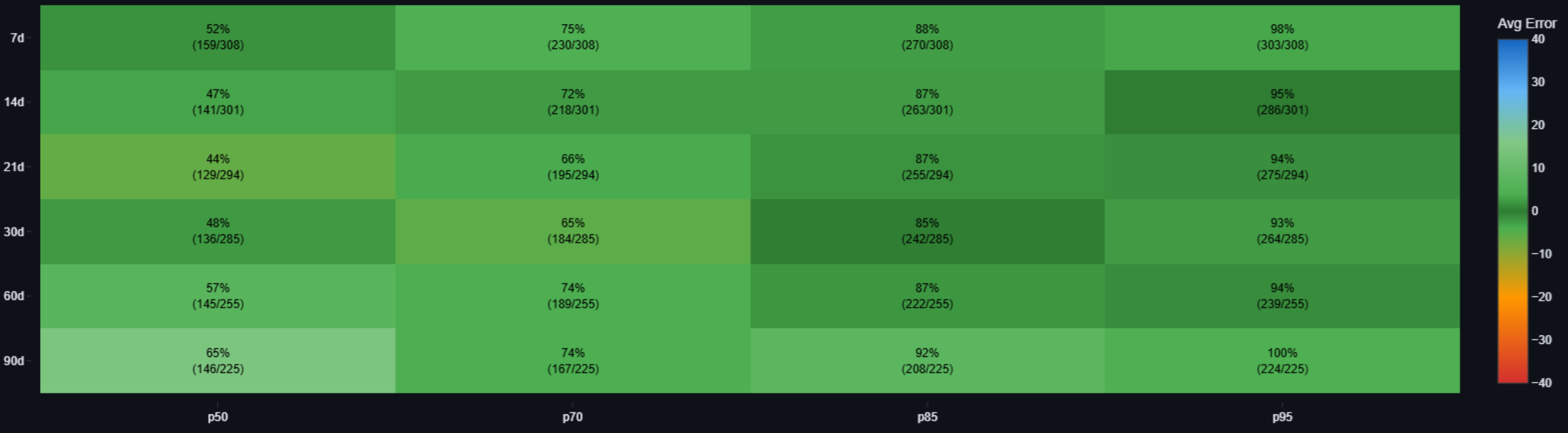
If you are noticing a lot of green boxes, that is because this team was nearly perfect with their forecasts. Look at the 30-day horizon and trace it to the 85% confidence level. The intersection shows a perfect 85% hit rate. This same pattern appears in the 14-, 21-, and 60-day forecasts. The Project Unicorn team was exceptionally predictable at both short- and long-term horizons.
The Lesson: This is a masterpiece of predictability. We mathematically expected the team to hit their target 85 times out of 100, and they were usually extremely close. Their forecasts were tightly bound and consistently conservative (meaning if they missed, they usually delivered more than expected), which is the safest possible direction of forecast error. Because the team and Product Owner actively managed their flow, strictly limited Work In Progress (WIP), and used data to make quick, informed decisions, their system remained stable. Even when known capacity drains hit (like Thanksgiving and Christmas holidays), they absorbed the slowdown without breaking the math. If there was a poster child for how an empowered Agile software delivery team should work, this team was it.
Archetype 2: Project Pressure Cooker (The WIP Explosion)
Coming off a successful major launch, this team initially felt in control. But as they transitioned into work heavy with external dependencies, they hit a dangerous corporate mandate: intense pressure to deliver a fixed amount of scope by a fixed date. In other words, they adopted a project mindset instead of a product mindset.
Culturally, the team suffered from the classic hands-on-keyboard fallacy. If a developer was not actively writing code, they were viewed as unproductive.
The Trap: When developers hit an external blocker, they did not swarm to resolve it. To stay "busy," they flagged the blocked item and pulled a new card. They optimized for being busy rather than being predictable.
The Breaking Point: Shortly after the major launch, the system choked. Work In Progress skyrocketed until every developer had at least two active cards assigned at one point. The moment WIP exploded, cycle time rose sharply, eventually resulting in less throughput. This is a textbook example of Little's Law: average cycle time = average WIP / average throughput. As WIP increased, items took longer to complete.
The Heatmap Data: Let us walk through the heatmap for this team.
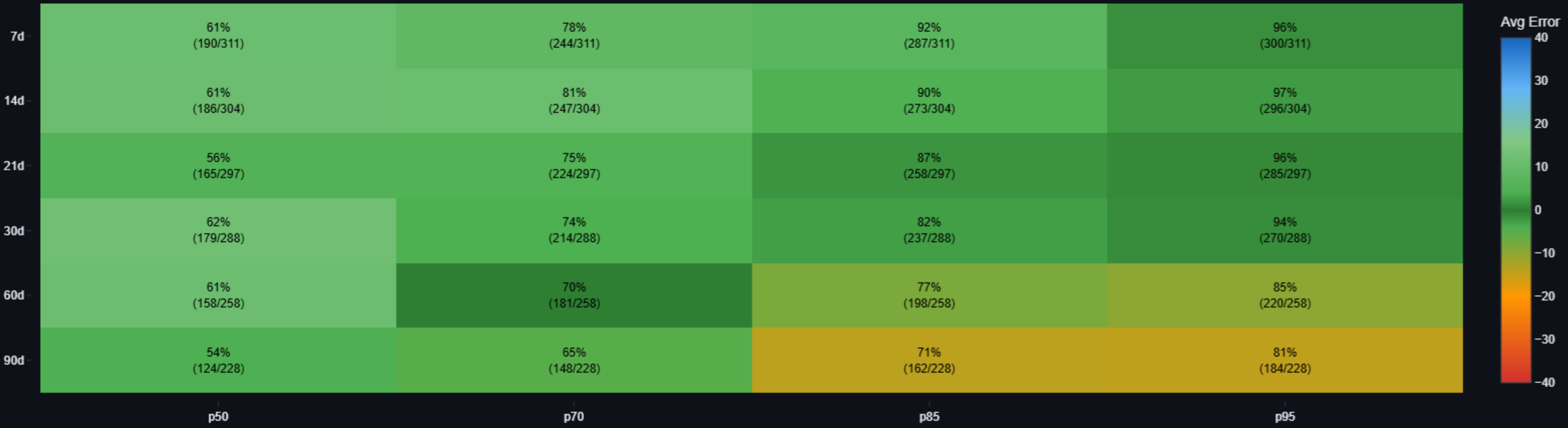
Notice how the top half is mostly green, but it bleeds into yellow and orange as you look lower? This is system instability rearing its head. Look at the 85% confidence column. In the short term (7 and 14 days), they hit 92% and 90% hit rates, everything looks great. But as the timeline extends: 90% -> 87% -> 82% -> 77% -> 71%. That shift from green to orange is the visual footprint of a smooth slide into unpredictability. Their short-term forecasts looked healthy, but long-term predictability suffered from WIP overload.
The Lesson: It is tempting to look at those accurate short-term forecasts and assume the math built a temporary safety net, but that is not what happened. The long-term forecasts did not fail because of a mathematical quirk. They failed because the team violated the single most important rule of Monte Carlo forecasting: your future system must look roughly like your past system.
When the team's WIP exploded, they fundamentally altered the physics of their workflow. According to Little's Law, when WIP increases massively without a proportional increase in throughput, cycle time must skyrocket. The system choked on context switching and queues.
So why did the shorter-term forecasts survive? Because throughput is a lagging indicator. When you flood a system, it does not grind to a halt on day one. The team managed to push a few already-in-flight items across the finish line through sheer heroics, making the short-term math look okay. But over 60 and 90 days, the suffocating reality of the broken system set in. The algorithm was predicting the future using historical data from when the system was healthy, so it was forecasting a reality that no longer existed.
Archetype 3: Project Conformity (The Ghost Capacity Trap)
This team faced a trap I see large organizations fall into often: intense pressure to do things the way other teams do them. Organizations often view rigid team governance as the ultimate risk-control lever. It is easy to think, "If all teams operate the exact same way, there should be less variability, right?" But this illusion of control stripped the team of autonomy, forcing them to abandon continuous flow and measure success by velocity and story points instead.
The Trap: When you measure a team by how fast they burn down imaginary points, you force a feature-factory mindset. They stopped managing the actual flow of work and just tried to keep velocity charts looking pretty. But the real danger of this conformity was not just inefficiency, it was complete loss of agency. When inevitable project realities hit (like shifting priorities or team members rolling off the project), they lacked the psychological safety and invested Product Owner support to push back. They were forced to absorb disruption without renegotiating scope.
The Heatmap Data: Let us walk through the heatmap for this team.
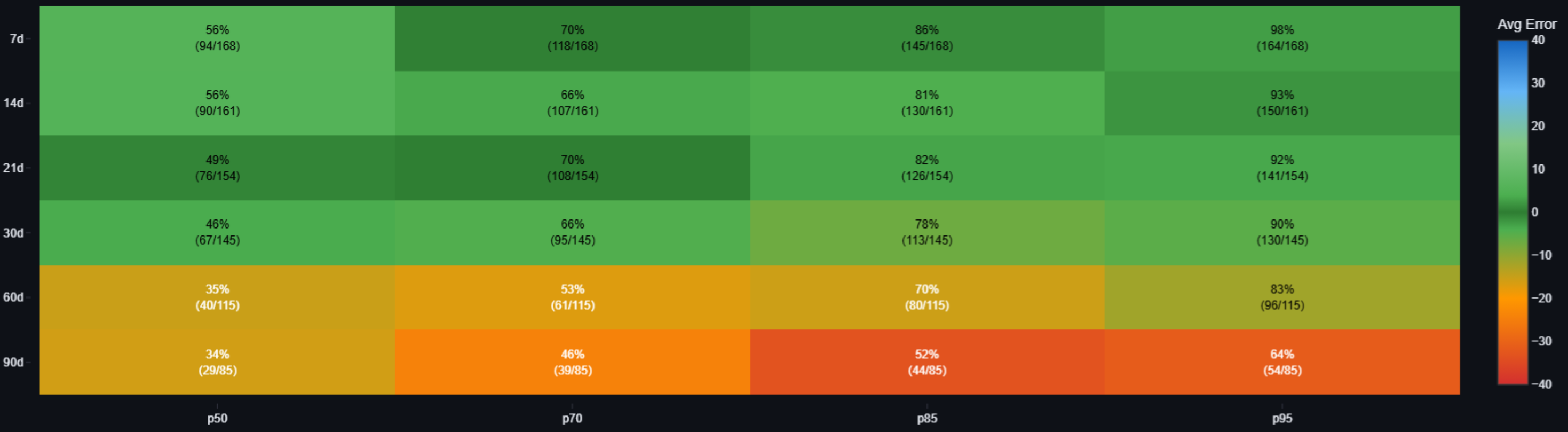
If you are seeing orange and red dominating the bottom half, that is the visual indicator of a system in freefall. Trace down the 85% confidence column. While they managed to hang on in the very short term, by the 60-day mark they dropped to 70% (yellow). By the 90-day horizon, the intersection hit only 52% (dark orange), barely better than a coin flip. Their 85% long-term forecast became meaningless as a planning instrument because it carried no more information than random chance.
The Lesson: Predictability requires autonomy. Project Conformity did not fail because they used the wrong forecasting math. They failed because a culture of forced conformity stripped them of the autonomy needed to manage their own flow.
In predictive forecasting, system stability is the absolute prerequisite for a trustworthy projection. But here is the hard truth about system dynamics: you cannot have a stable system if the team operating it is not allowed to pull the levers. When a team is forced into a rigid, one-size-fits-all process, they lose the ability to dynamically manage Work In Progress. They lose authority to push back on bad scope, prioritize blocked items, or restructure queues when bottlenecks emerge. Instead of optimizing the flow of value, the team is forced to optimize for compliance.
By removing the team's autonomy to adapt to their specific context, the organization introduced massive, artificial variability into cycle times. The Monte Carlo simulations failed because the team was no longer in control of its own physics. They proved that standardizing the process does not standardize the outcome. A forecast can only be as predictable as the team is empowered.
The Bottom Line
We are standing on the edge of an AI revolution in software delivery. Soon, AI will be able to run these forecasts instantly, automatically flag WIP explosions before they happen, and dynamically update forecasts as conditions change.
But here is the hard truth: AI cannot fix a broken culture.
An AI model crunching data from a team stripped of autonomy will simply give you a highly precise, mathematically perfect failure date. A forecasting model, whether it is powered by a Monte Carlo script or a next-generation LLM, is only as good as the stability of the system it measures. If your team is choking on WIP, incentivized to prioritize busyness over finishing, or lacks authority to push back on bad scope, the best algorithms in the world will not save you.
Predictability is not just a math problem, it is a culture problem. Empowered teams are the only real mechanism for predictable delivery. When teams have the authority to limit WIP, negotiate scope, and adapt to changing environments, we can finally stop guessing and give the business dates it can trust.
If you are tired of throwing darts at a calendar, or if your delivery metrics look more like systemic collapse than a masterpiece of predictability, it may be time to change the equation. At Leading EDJE, we help organizations break the cycle of guesswork by pairing advanced flow metrics with truly empowered engineering cultures.
Let us stop guessing and start delivering. Reach out to our team to see how we can help your teams build their own masterpiece of predictability.